
Original research · Arrests & Enforcement
Texas Marijuana Arrest Records Change Between DPS Workbooks
The short answer
The same 2024 arrest year produces 39,468 selected marijuana-coded records in a DPS workbook as of January 7, 2025, and 39,791 in the workbook as of January 13, 2026—a difference of 323. These are two versions of the same year, not a 2024-to-2025 increase in enforcement. The files do not explain the difference.
On this page 9 sections
The same year, two retained source versions
TCL applied the same broad text-selection rule to each workbook: select county/offense rows containing MARIJ or MARIHUANA in the offense or statute text, including mixed CS/MARIJ labels, and sum adult and juvenile columns. Both of these workbooks separate those age columns. This comparison does not rely on older, unsplit-age files.
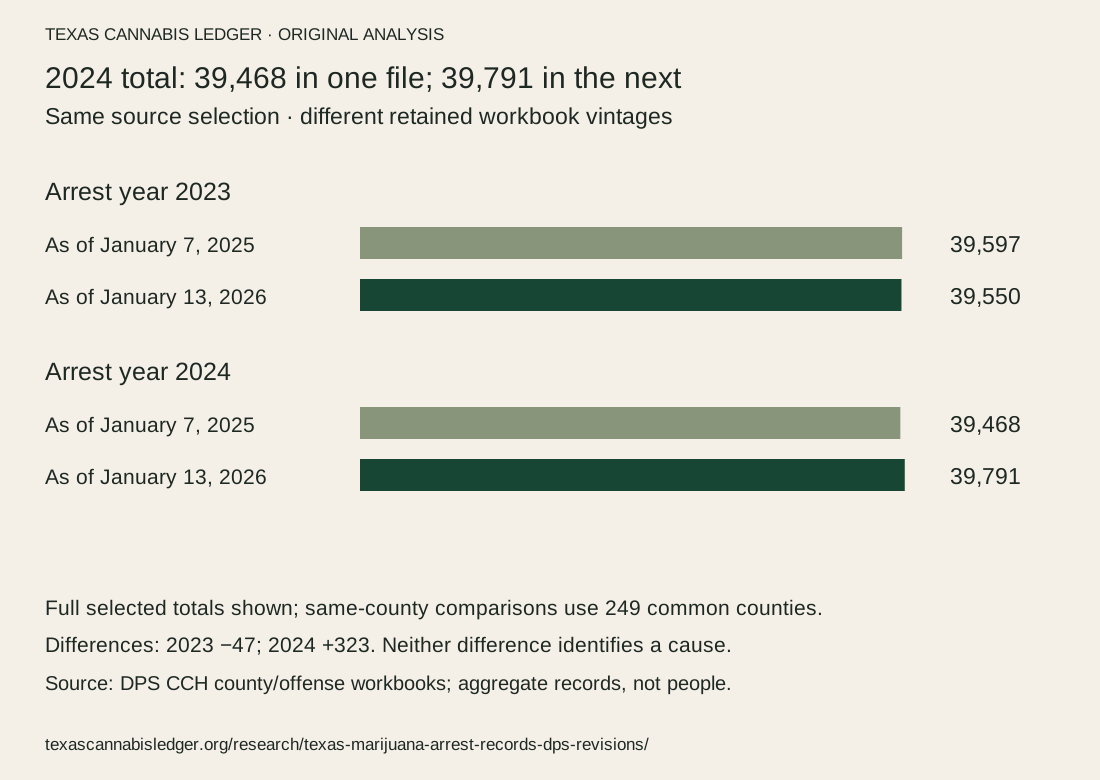
| Arrest year | As of Jan. 7, 2025 | As of Jan. 13, 2026 | Later minus earlier |
|---|---|---|---|
| 2023 | 39,597 | 39,550 | -47 |
| 2024 | 39,468 | 39,791 | +323 |
The 2023 selected total is lower in the later workbook, while the 2024 total is higher. Later files do not simply add records uniformly. A difference in either direction does not establish which version is more accurate or identify a submission, correction or classification process.
The “2025” and “2026” file labels identify workbook versions here. They must not be mistaken for the arrest year being compared. DPS says arrest counts are assigned using the reported arrest date.
County values change even when the statewide difference looks small
For arrest year 2024, 112 of the 249 counties with selected rows in both files have a different selected count. Increases and decreases partly offset; the statewide net does not describe the size or direction of every county’s difference.
| Arrest year | Common counties changed | Upward differences | Downward differences | Net |
|---|---|---|---|---|
| 2023 | 57 of 249 | +49 | -96 | -47 |
| 2024 | 112 of 249 | +357 | -34 | +323 |
These are changes between source versions for the same arrest year. They are not newly measured year-to-year changes in county policing. A county appearing in this table is not evidence that an agency made an error.
The complete download preserves every common-county comparison, including unchanged counts, rather than only the counties with the largest differences.
Why compare 249 counties when each workbook has 250 matches?
Each file has matching selected rows for 250 counties, but they are not exactly the same counties. Stonewall appears only in the earlier selected-row inventory; Lipscomb appears only in the later one. Their selected values are zero in both overlapping arrest years where a row exists.
Consequently, the full selected totals and the common-county totals happen to agree in this particular comparison. We still keep the universes separate. A missing row is not automatically a zero, and the same convenience must not be assumed for other releases.
The comparison cannot label either county a nonreporting jurisdiction. It establishes only the presence or absence of selected rows, not completeness of all agency submissions.
A source refresh can change the direction of a small county trend
Comparing 2023 with 2024 inside each workbook changes the up/down/unchanged label in 11 common counties. Only two change strictly from a decrease to an increase: Callahan and Colorado. The other nine change to or from an unchanged count.
| County | Earlier file: 2023 → 2024 | Earlier change | Later file: 2023 → 2024 | Later change |
|---|---|---|---|---|
| Callahan | 19 → 18 | -1 | 19 → 20 | +1 |
| Colorado | 21 → 19 | -2 | 23 → 24 | +1 |
These are small absolute counts. “Eleven counties reversed their trend” would overstate the evidence. Nor do these examples establish a statewide policy effect. They show how a claim about a small county can depend on which source version a publisher used.
Do different offense definitions explain it?
The broad selection is not the only way to define a marijuana-related series. As a check, TCL separately matches the two base-possession categories corresponding to current identifiers 35620008 and 35620009, using the older file’s offense labels and statutory citations where numeric identifiers are absent.
For arrest year 2024, that narrower subset changes from 34,911 to 35,181 between these two files, a net difference of 270. For 2023 it changes from 34,431 to 34,383, a difference of −48. The differences therefore persist under this narrower matching rule, but their size depends on the definition.
This does not prove the underlying offenses or charge outcomes are fully comparable. The older file also contains two repeated selected county/offense/statute/citation keys, in Cameron and Williamson, outside the base-possession subset. We retained the supplied counts rather than deciding without evidence that they were duplicate incidents or safe to delete. The raw labels do not identify the reason for a repeat or change.
Do not call the broad selected total “all marijuana arrests” or the two-code subset “all low-level enforcement.” Other aliases, enhancements and THC classifications can fall outside either description.
What can we say about why the numbers changed?
The retained files establish that the selected values differ. They do not contain a change log tying each difference to a late submission, deletion, record correction, code change or another mechanism. Those remain possible explanations, not findings of this report.
TCL has not matched individual records across the files. The aggregates cannot identify how many unique people were affected, whether a specific event was added or removed, whether the same event was reclassified, or whether a case was prosecuted or resulted in a conviction.
Calling every difference a “late-reported arrest” would assume an explanation the source does not provide. Calling every difference an error would do the same. A precise description is a difference in selected source counts between the retained workbooks.
This is different from comparing DPS with FBI-based figures
TCL’s existing guide to different Texas marijuana arrest totals compares DPS CCH figures with an FBI-derived reporting path. That is a comparison between systems and their definitions.
This report holds the source agency constant and compares two workbook vintages. The findings do not reconcile the DPS/FBI gap. They explain another reason two publishers—or two copies of the same analysis—might quote different figures without having used the same underlying file.
Which figure should a reader cite?
For a current lookup, identify the actual workbook, its as-of date, the arrest year, the selection rule and the count. For a historical comparison, retain the source version used for every year. Do not silently combine older and newer extracts and describe the resulting differences as purely changes in enforcement.
A file’s download date alone is insufficient: agencies may reuse URLs, and a local rebuild is not a new source verification. A SHA-256 checksum identifies the exact bytes used; it does not certify accuracy or complete reporting.
Example: “Using the DPS county/offense workbook as of January 13, 2026, TCL counted 39,791 selected marijuana-coded records for arrest year 2024.” A comparison with the earlier workbook should state its January 7, 2025 as-of date and its 39,468 count too.
Data, method and reuse
Download the complete calculation bundle · ZIP · Source identities and definitions · JSON
Revision summary · CSV · All common-county comparisons · CSV · All changed trend labels · CSV
The bundle includes all 254 county statuses for both overlapping arrest years in both source versions: 1,016 input rows. Its tables preserve common-county differences, separate base-possession results, coverage changes and trend-label changes. Original workbook URLs, checksums and definitions are in the source metadata. The government workbooks themselves are not redistributed.
After extraction, run python3 -I reproduce.py. The portable script checks its manifest and reproduces the arithmetic from normalized aggregates. It does not independently reconstruct the original workbook selection or establish why the source changed. The separate raw-source checks for this report confirm the documented source-to-input rule without supplying a causal explanation.
Release boundary: TCL’s public research release v0.1.0 contains only the first two concentration findings. This revision study is not included in it. The website bundle is not an additional published GitHub release.
Suggested attribution: Texas Cannabis Ledger, “Texas Marijuana Arrest Records Change Between DPS Workbooks,” comparing 2023 and 2024 arrest-year counts in the workbooks as of January 7, 2025 and January 13, 2026. State the selection, county universe and file versions, and link the report and original sources. The calculations are TCL’s; the source records are DPS’s.