Original research · Arrests & Enforcement
Harris County Marijuana Arrest Records: What Changed?
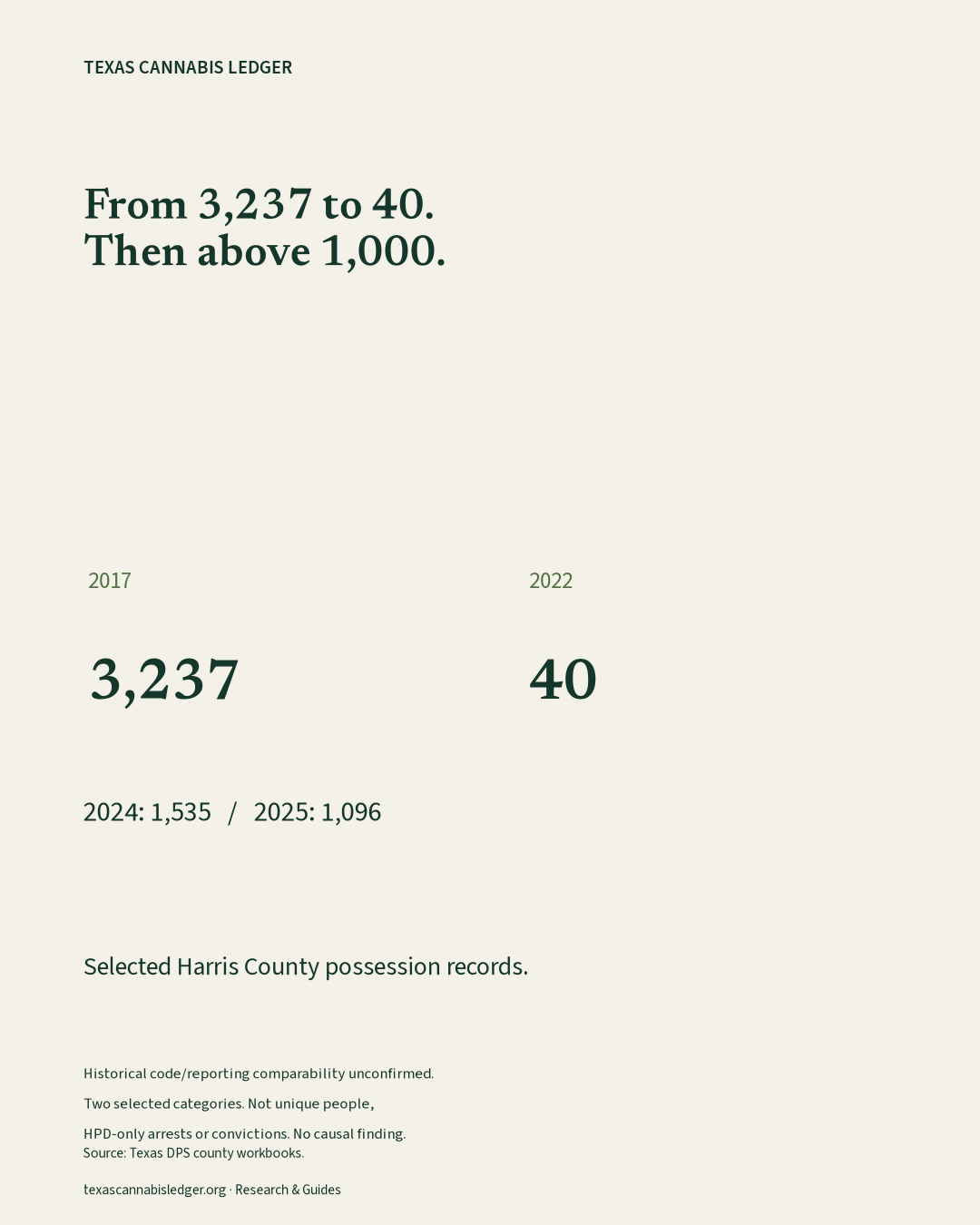
- 2017
- 3,237 Before the trough
- 2022
- 40 Lowest reconstructed count
- 2024
- 1,535 Rebound
- 2025
- 1,096 Latest reporting year
Selected possession records, not unique people. Historical code and reporting comparability remain under review.
The short answer
The records show a collapse and rebound. Explore the annual counts, compare Harris County with the rest of Texas, and inspect the policy documents. The causes remain an open question; historical reporting comparability is not confirmed.
For journalists Finding, downloads, attribution & contact
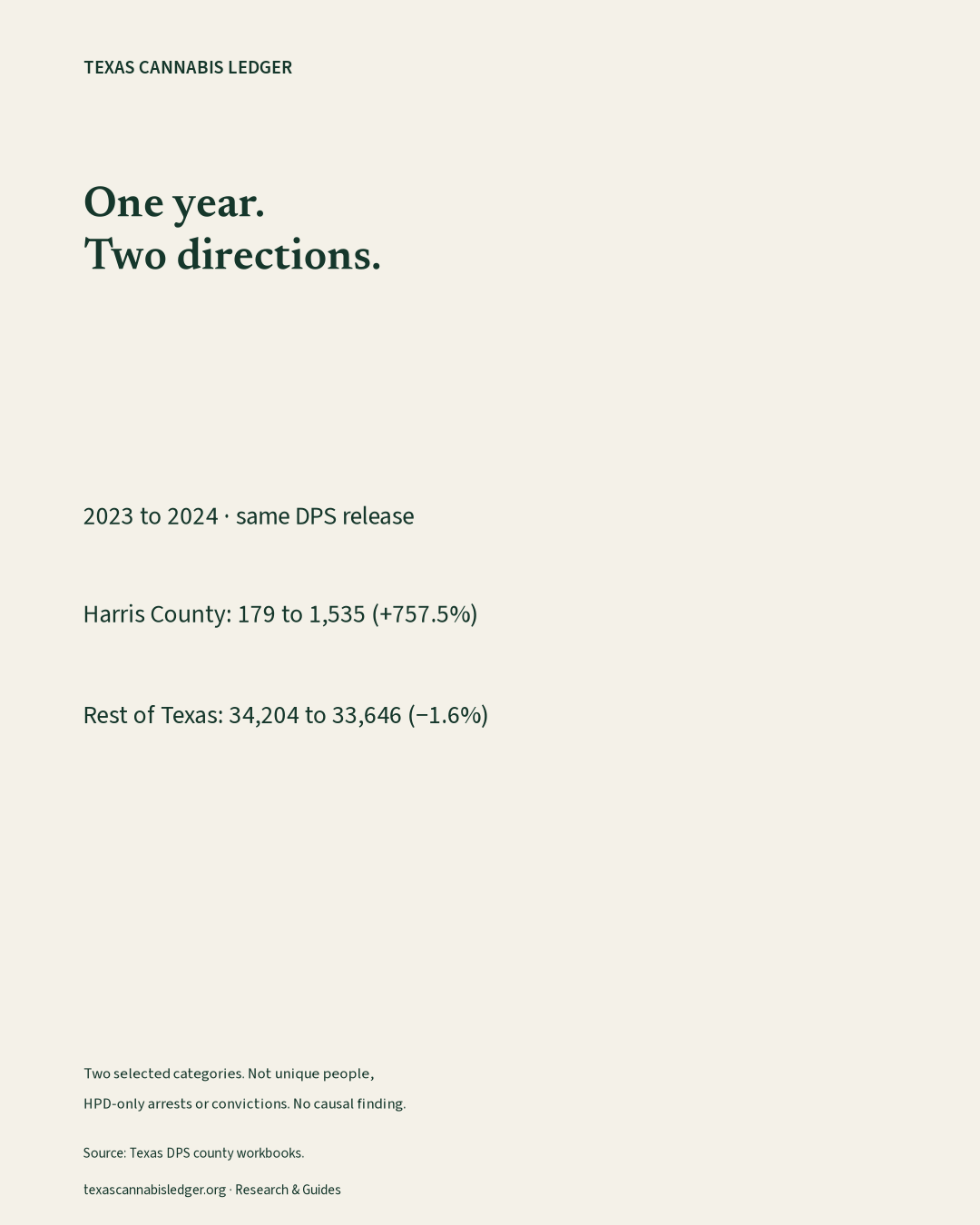
In the same DPS release, Harris County’s two selected possession categories rose from 179 records in 2023 to 1,535 in 2024, while the rest of Texas declined 1.6%. The longer reconstruction shows a 2020–2022 trough. The records do not establish causes or isolate HPD activity.
Suggested attribution: Texas Cannabis Ledger analysis of Texas DPS county arrest workbooks, two selected misdemeanor marijuana-possession categories. Historical crosswalk and reporting comparability remain under review. Link to this article and identify the reporting years.
Explore the records over time
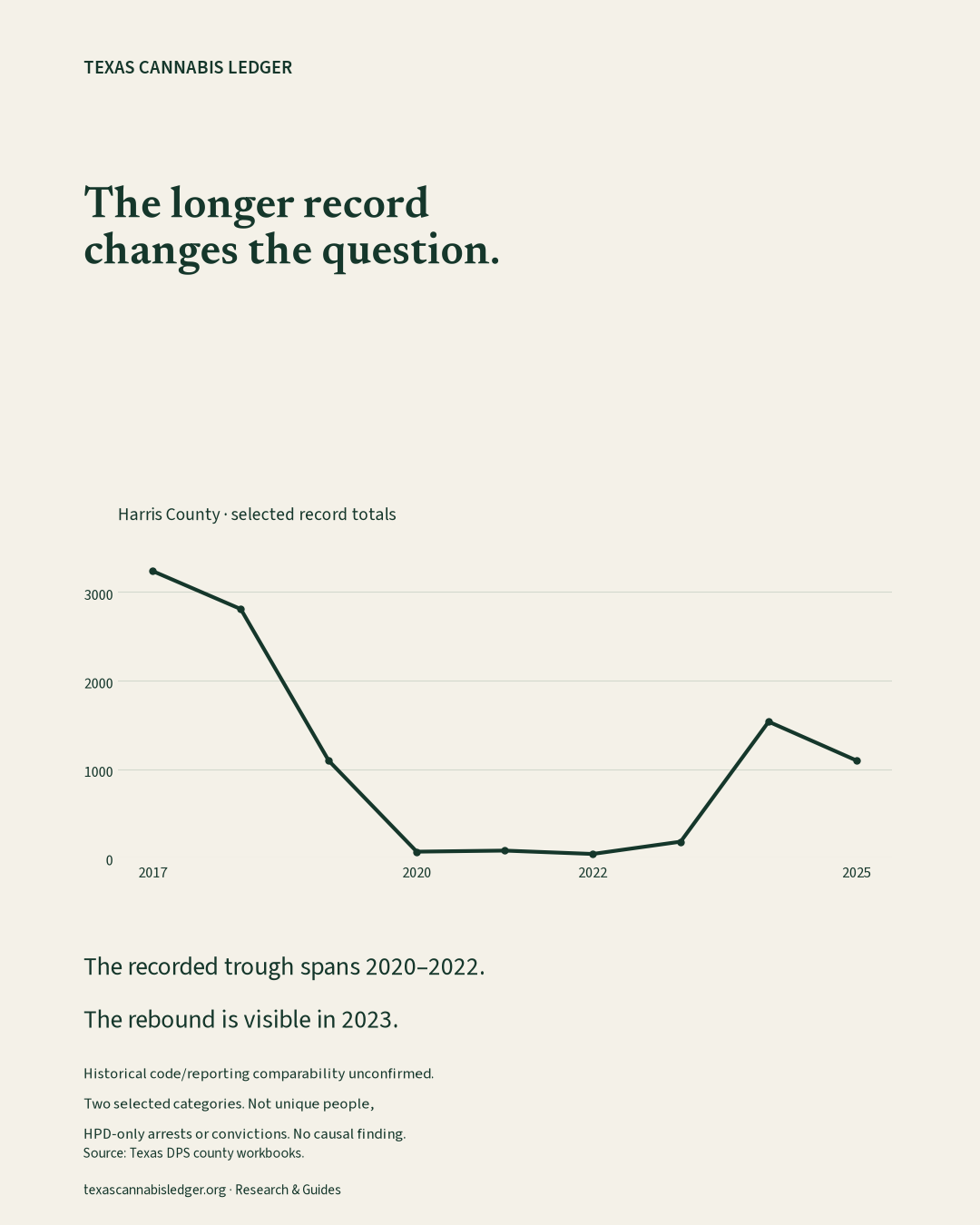
Absolute record counts. Panels have different vertical scales; compare numbers within each labeled panel.

On this page 7 sections
The numbers, year by year
The measure is deliberately narrow: two base misdemeanor marijuana-possession categories in Texas DPS county arrest workbooks. The table counts records assigned to Harris County and the same categories assigned to other Texas counties. It does not count every marijuana-related offense.
| Year | Harris County | Rest of Texas | Source release |
|---|---|---|---|
| 2017 | 3,237 | 76,704 | 2017-2021 |
| 2018 | 2,808 | 79,121 | 2018-2022 |
| 2019 | 1,094 | 62,862 | 2018-2022 |
| 2020 | 66 | 38,279 | 2018-2022 |
| 2021 | 78 | 37,213 | 2018-2022 |
| 2022 | 40 | 36,563 | 2022-2024 |
| 2023 | 179 | 34,204 | 2023-2025 |
| 2024 | 1,535 | 33,646 | 2023-2025 |
| 2025 | 1,096 | 36,202 | 2023-2025 |
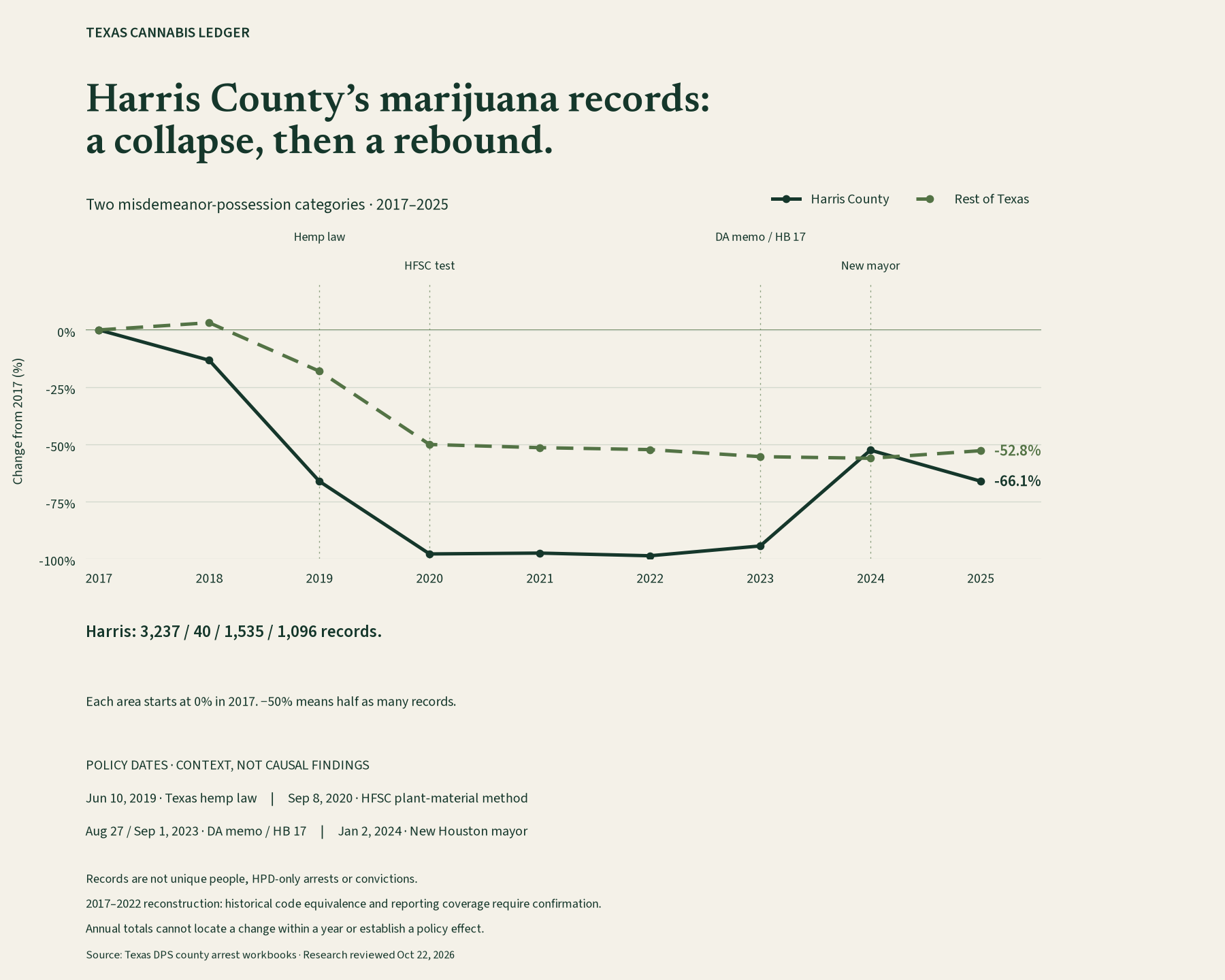
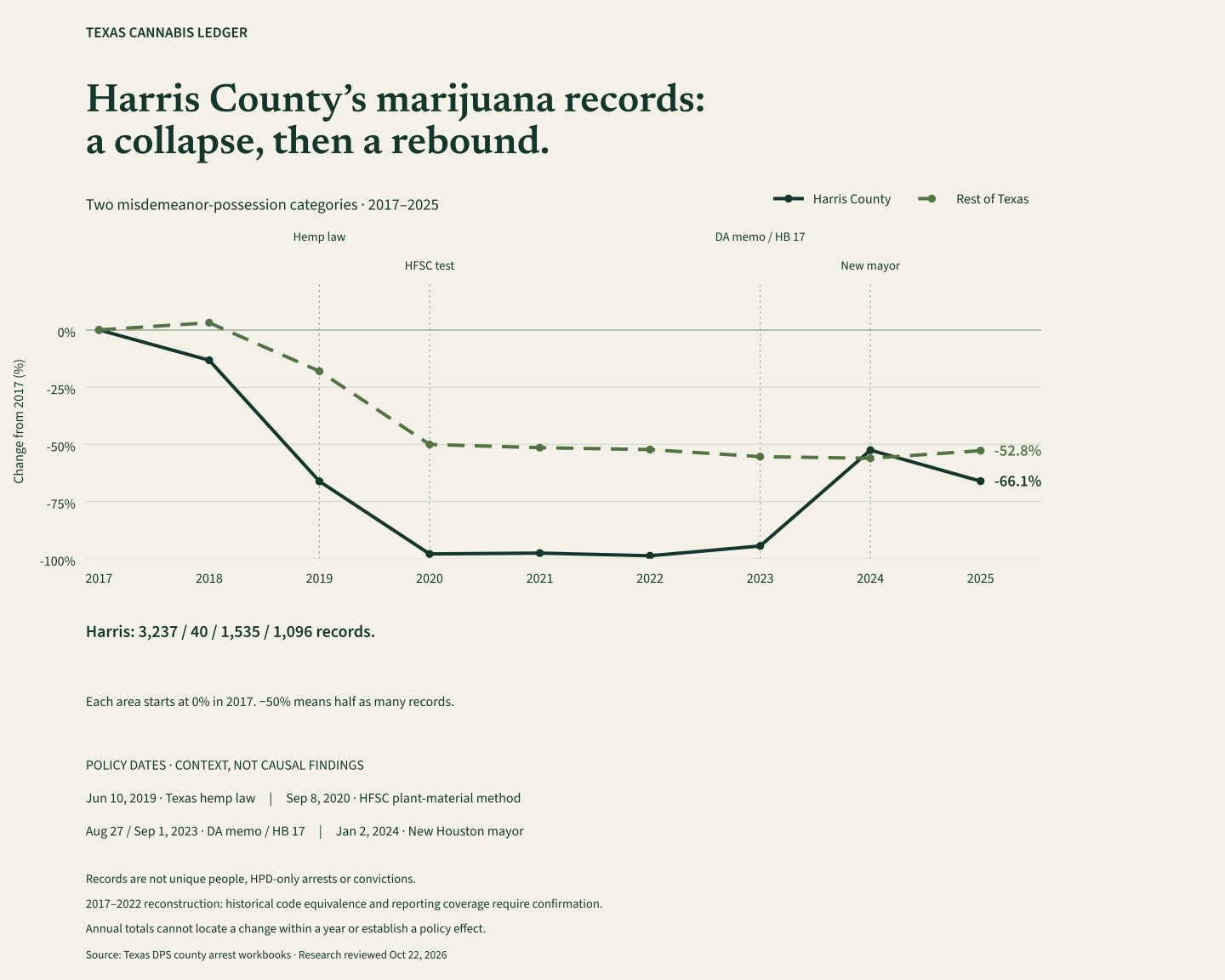
The long view matters. The reconstructed trough spans 2020–2022. The rise is already visible in 2023, before Houston’s 2024 mayoral transition. The 2025 count is approximately the 2019 count, rather than the high point of the reconstructed period. Those observations describe the retained records; they do not measure all police encounters or explain changes in reporting.
The older workbooks have different layouts and no separate age columns. We matched exact offense labels and statutory citations to the newer categories. Read the method below before treating the nine years as a continuous enforcement measure. A county appearing in a workbook is not proof that every agency reported completely.
Harris County and the rest of Texas moved differently in 2024
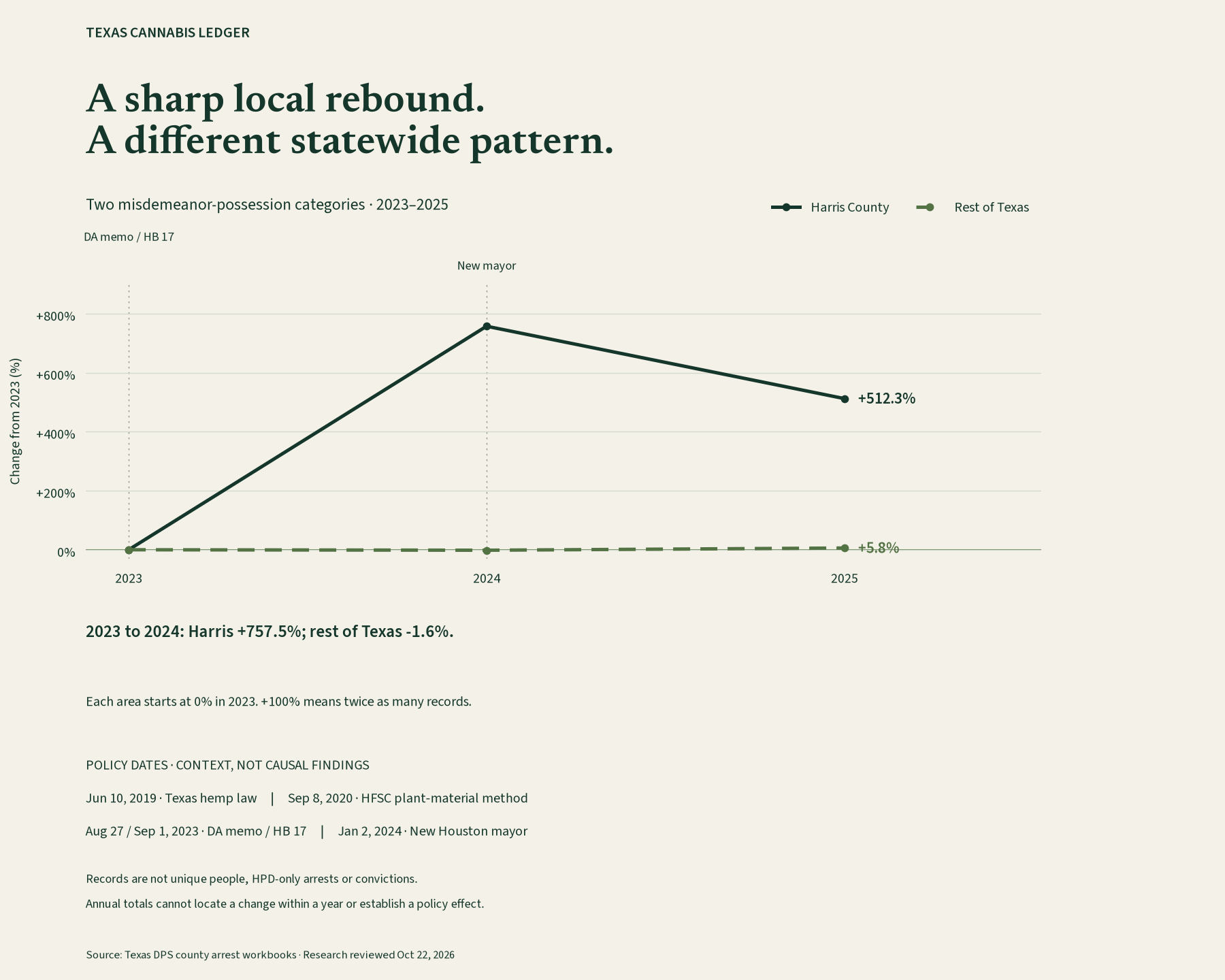
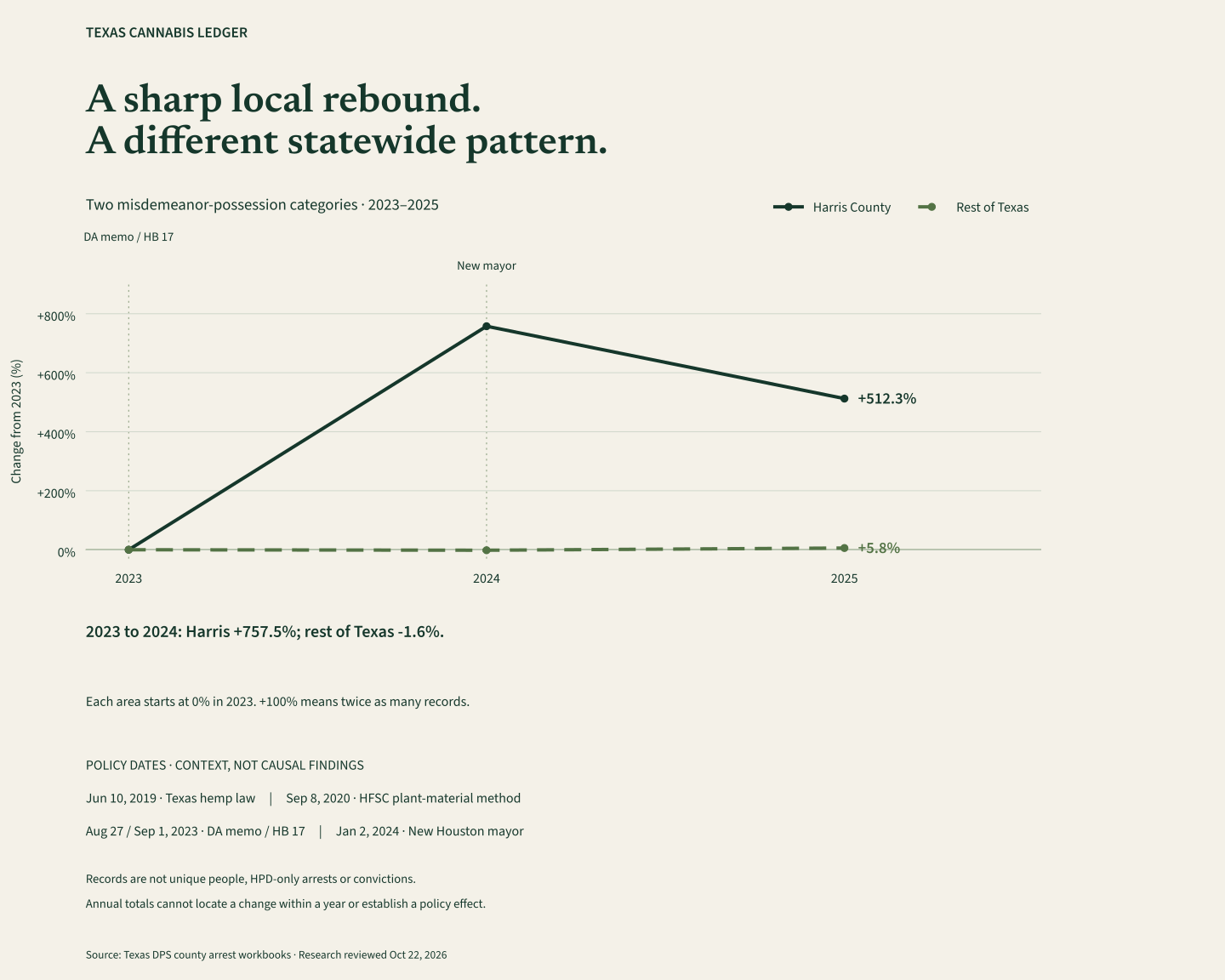
The cleanest recent comparison uses the same two offense identifiers, adult-plus-juvenile counts and one DPS release for both geographies. From 2023 to 2024, Harris County’s count rose 757.5%, while the rest of Texas declined 1.6%. The statewide total, including Harris, rose 2.3%. Inspect the 2023–2025 workbook.
| Geography | 2023 records | 2024 records | Change |
|---|---|---|---|
| Harris County | 179 | 1,535 | 757.5% |
| Rest of Texas | 34,204 | 33,646 | -1.6% |
| Texas, including Harris | 34,383 | 35,181 | 2.3% |
The calculation is (later count ÷ earlier count − 1) × 100. “Rest of Texas” means the sum of matching rows assigned to counties other than Harris. It is a geographic comparison, not a control group in an experiment. Changes in reporting completeness, population or agency practices have not been adjusted away.
The longer statewide record also declines. It would be inaccurate to describe the rest of Texas as stable throughout 2017–2025. The narrow recent divergence is the finding: the two geographies moved in opposite directions in 2024.
In 2025, Harris County’s selected count fell 28.6% from 2024. It still exceeded 2023. The county hub’s broader marijuana-coded totals answer a different counting question and should not be substituted for this series. Open Harris County’s public record or read why arrest totals differ.
The policy record, alongside the numbers
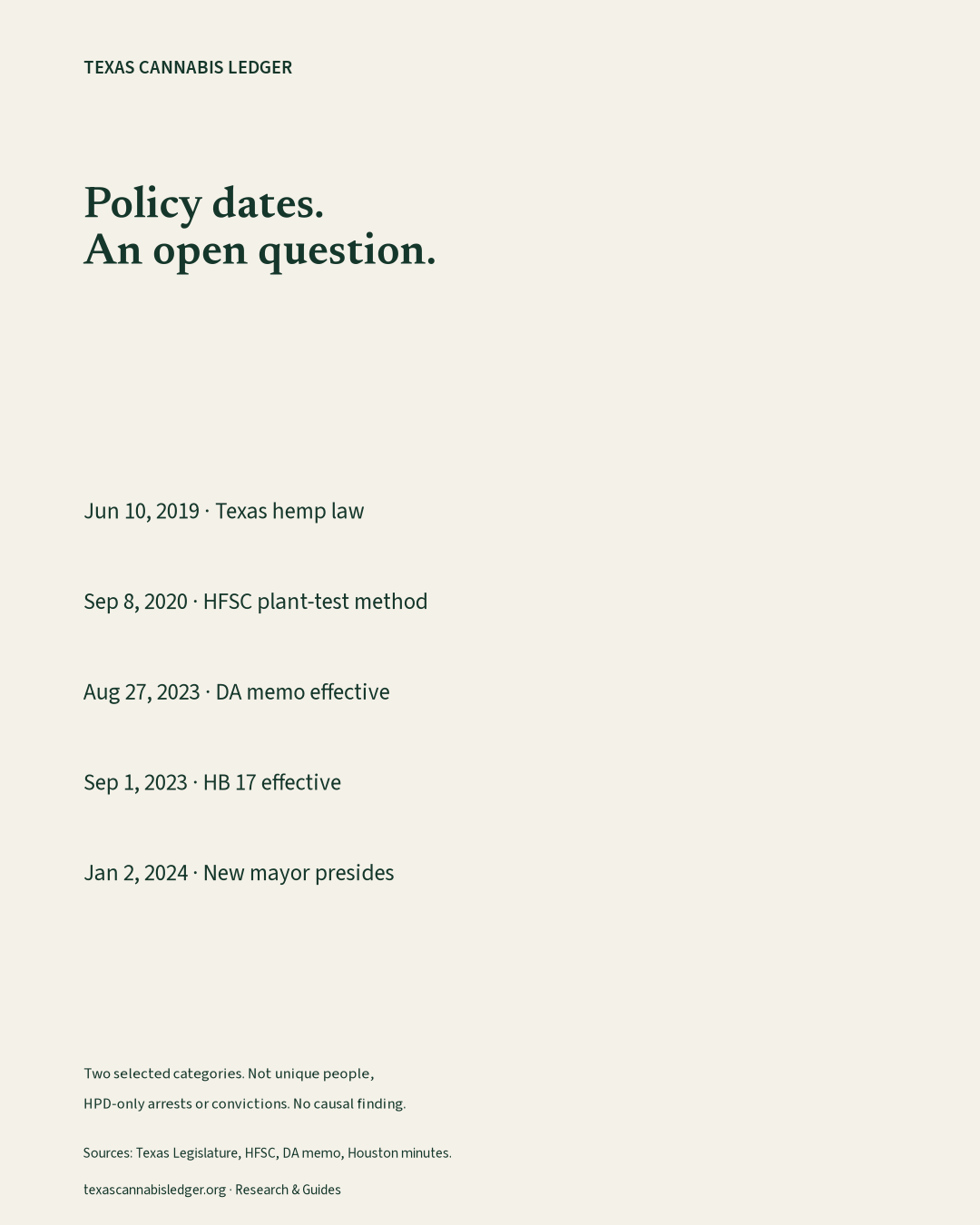
These documents establish dated laws, instructions or descriptions. Their placement beside the chart does not establish that they produced a particular change. Annual totals cannot show whether a change occurred before or after an event within the same year.
Diversion provides a documented route outside arrest and charging
The DA’s current public description calls the Misdemeanor Marijuana Diversion Program a pre-charge program and says successful participants avoid an arrest or possession-charge record. That describes the program, not how many people used it in a particular historical year. Read the DA’s program description.
The sheriff’s posted policy 512 instructs deputies to release eligible participants and not file a DIMS transaction, while retaining an offense report. Its revision history includes 2017, 2021 and 2025 entries. This is evidence that an encounter can be documented without following the ordinary charging path. The currently posted text does not establish the exact policy applied by every agency during 2020–2022, or how a particular encounter reached DPS. Read policy 512, especially procedures C–D and the revision history.
June 10, 2019: Texas’s hemp law takes effect
HB 1325 established Texas’s hemp framework. Its official history records June 10, 2019 as the effective date. It did not generally legalize recreational marijuana. Read the official legislative history and TCL’s hemp-law guide.
September 8, 2020: Houston’s forensic lab announces a limited test
HFSC’s original announcement describes testing difficulties after the hemp law and says some prosecutors, including those in Harris County, requested laboratory evidence distinguishing marijuana from hemp. It announced a plant-material method with a 1% THC threshold; the stated method did not cover oils, waxes or edibles. That testing threshold was a methodological limitation, not a new legal limit. Read the announcement, pages 1–2.
The county counts remained low in 2021 and 2022 after this announcement. Laboratory constraints are therefore relevant context, not a complete explanation of the trough. The release does not supply annual test volumes, agency referrals or the number of cases affected.
August 27, 2023: a DA screening directive takes effect
Kim Ogg’s August 24 memo directs evaluation of drug-possession cases for direct filing, effective August 27, citing fentanyl concerns. It discusses probable cause and laboratory analysis. The memo does not name marijuana or explicitly cancel the marijuana diversion program. Read the original one-page memo.
Later Houston Public Media reporting describes disagreement over whether the directive explains increased marijuana prosecutions. That is an attributed dispute, not a finding resolved by this dataset. We have not independently reproduced the court-case totals in that reporting. Read HPM’s September 10, 2026 report.
September 1, 2023: HB 17 takes effect
HB 17 addresses prosecutors’ categorical non-prosecution policies. Its text expressly includes exceptions for evidentiary impediments and legally permissible diversion. It does not establish that every low-level marijuana case must be prosecuted. The statute and its date are context; the county totals do not identify an effect of the law. Read section 1 of the enacted text and the effective-date record.
January 2, 2024: Houston’s new mayor presides at council
Official minutes record John Whitmire presiding at the January 2 meeting. The Harris County series had already risen during 2023. These countywide annual totals cannot isolate the effect of a mayoral administration, DA policy or any individual agency. Read the council minutes.
What this tells Houston voters about Proposition A
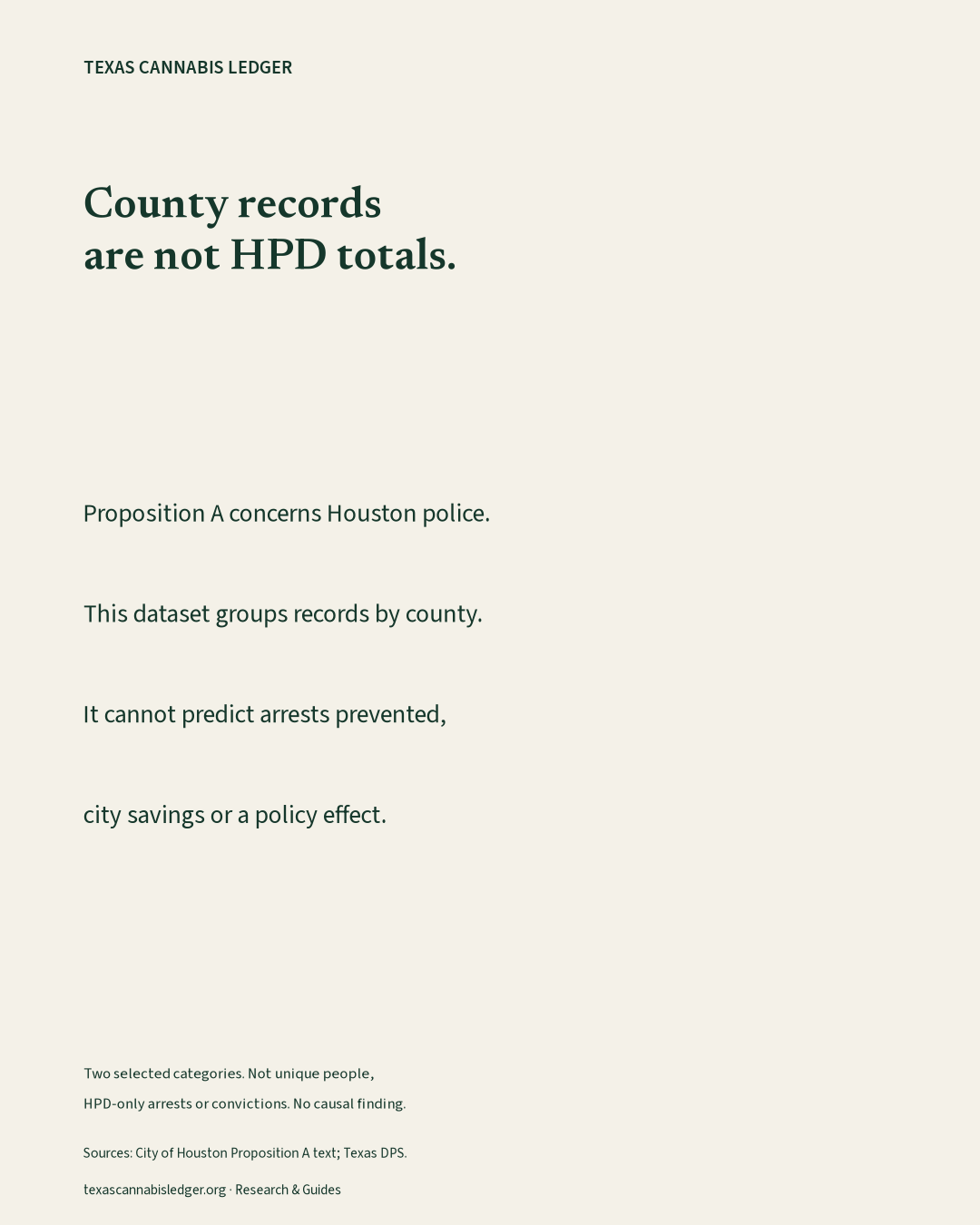
Houston’s official notice schedules the Proposition A vote for November 3, 2026. The proposal addresses HPD’s enforcement priority for Class A and B misdemeanor marijuana possession, related reporting and no-knock warrants. It is a city charter proposal, not a statewide marijuana-law change. Read the official ballot and proposed charter text.
Proposed sections X.08 and X.09 call for an HPD retrospective audit and reporting on arrests, citations, demographics, diversion referrals and staff time. Those are agency-specific measures the county workbook does not provide. The county series is useful context for the public question, but cannot calculate arrests the proposal would prevent, costs it would save or an effect on racial disparities. Read the existing Proposition A explainer.
All years plotted precede the scheduled vote. Proposition A cannot explain these historical changes. This analysis does not recommend a vote or attribute the pattern to a political party, official or policy.
Questions readers may bring to these records
How many people were arrested for weed in Houston?
This dataset cannot give that exact answer. It contains county-assigned offense records, including selected adult and juvenile counts in newer releases. It does not identify unique people, separate HPD from other agencies or isolate incidents within Houston city limits. The 2025 Harris figure in this analysis is 1,096 selected records, not 1,096 identified Houston residents.
Why were the Harris County counts so low in 2020–2022?
The aggregate workbooks do not establish why. Diversion, laboratory constraints, pandemic-era operations, police practices and record submission are possible factors to examine. This page documents records and policy context without selecting a causal explanation. Low recorded counts are not proof that marijuana possession stopped occurring or that police made no related stops.
Does this show how many people went to jail or were convicted?
No. The workbooks do not provide linked custody, prosecution or case-outcome histories. An arrest record is not a conviction, and a charge record is not necessarily a distinct arrest event. Court figures from another reporting system cannot simply be attached to these counts as outcomes for the same cases.
Does a low count mean weed was legal in Harris County?
No. State law, local enforcement priorities and diversion are different questions. Texas Health and Safety Code §481.121 generally prohibits knowing or intentional possession of a usable quantity of marijuana, subject to applicable law and exceptions. Historical counts cannot determine an individual case. Read the statute, the possession guide or the Harris attorney directory.
Are THC carts, concentrates and all marijuana offenses included?
No. The selected series uses two specific marijuana-possession categories, not every marijuana-coded category or every THC-related offense. Product-specific legal classifications and other offenses belong to different analyses. Read the concentrates, vapes and edibles guide.
Can I compare these figures with an HPD news investigation?
Only after matching definitions. Check the agency, county versus city geography, calendar or fiscal year, age coverage, offense codes, date field and unit counted. We reviewed published reporting but did not obtain the underlying HPD records responses. The figures here should not be described as an independent replication of those agency-level investigations.
How the reconstruction works
Offense selection, calculations, source dates and release revisions
Selection. In the 2023–2025 workbook, the current identifiers are 35620008 and 35620009, with HSC citations 481.121(b)(1) and 481.121(b)(2). The source labels are POSS MARIJ < 2OZ and POSS MARIJ <= 4OZ > 2OZ. The statute describes two ounces or less for the first category; we preserve the workbook’s label rather than silently correcting it. Drug-free-zone rows and separate legacy aliases are excluded.
Historical crosswalk. Older files do not expose those offense identifiers. We match the exact base labels and HSC citations, normalizing whitespace only. The selected release for each year is identified in the table and download. Older annual columns are unsplit; newer columns separately identify adults and juveniles, which we sum. This is a provisional crosswalk, not DPS certification of comparable capture across all years.
Geography. We sum selected rows labeled Harris County. The comparison sums selected rows labeled with other Texas counties. We do not reassign a record to a city, residence or police agency. Source rows and positive counts are separately reported in the machine-readable download; neither establishes complete agency reporting.
Calculations. Annual records are sums of selected cells. Percentage change is (later ÷ earlier − 1) × 100. The default chart shows record totals in separate panels with different vertical scales. The change charts show the percentage rise or fall from each area’s own starting count: 2017 for the long view, 2023 for the recent view. Zero percent means no change; −50% means half as many records and +100% means twice as many. These are changes in record counts, not population-adjusted rates or an individual’s probability of arrest.
Source dates. The current workbook says “as of” January 13, 2026; the preceding release says January 7, 2025. Those are source timestamps, not proven publication dates. The older files used here lack internal as-of dates. TCL retrieved and reviewed these sources on October 22, 2026. A future rebuild must not automatically advance that review date.
Revisions. Overlapping releases sometimes disagree. The table below shows earlier and later counts for Harris within the retained releases. We use the later retained release for each reporting year, rather than adding releases together or silently reconciling differences.
| Reporting year | Earlier release count | Later release count |
|---|---|---|
| 2018 | 2,834 | 2,808 |
| 2019 | 1,103 | 1,094 |
| 2020 | 64 | 66 |
| 2021 | 79 | 78 |
| 2022 | 40 | 40 |
| 2023 | 179 | 179 |
| 2024 | 1,534 | 1,535 |
For 2022, the older unsplit count of 40 also matches the later release’s 36 adult plus 4 juvenile records. That is a useful overlap check, not proof that historical age or reporting coverage is complete. Exact cell references, source hashes and all retained release observations are included in the calculation file.
Download, cite or examine the finding
- Annual records and chart indexes · CSV
- Calculations, Harris source cells, exclusions and release comparisons · JSON
- Source URLs, retrieval dates and SHA-256 hashes · JSON
- Historical comparison · PNG · SVG
- 2023–2025 comparison · PNG · SVG
Suggested attribution: “Texas Cannabis Ledger analysis of Texas DPS county arrest workbooks; two selected misdemeanor marijuana-possession categories. Historical crosswalk and reporting comparability remain under review.” Include the reporting years and link to this page. Do not describe the results as unique people, HPD-only arrests or proof of a policy’s effect.
The public question remains open: what changed in Harris County between the decline and the rebound? The records and dated policies provide a starting point for examining that question. Agency-level monthly records, diversion participation, laboratory submissions and reporting documentation could help readers and reporters distinguish explanations.
TCL’s About page discloses its publisher’s policy position. This analysis presents no voting recommendation, endorsement or claim that Proposition A caused an outcome. Corrections and additional primary records can be submitted through the contact information.
Share the research
Download the full-size graphics and captions. Keep their source notes and historical qualifications when sharing.
Preview the carousel