
Original research · Arrests & Enforcement
Marijuana Court Activity in Five Texas Counties
FY2025 OCA reports show different filing and disposition totals in five Texas counties. Inspect the figures, reporting definitions, source vintage and reproducible aggregate data.
The short answer
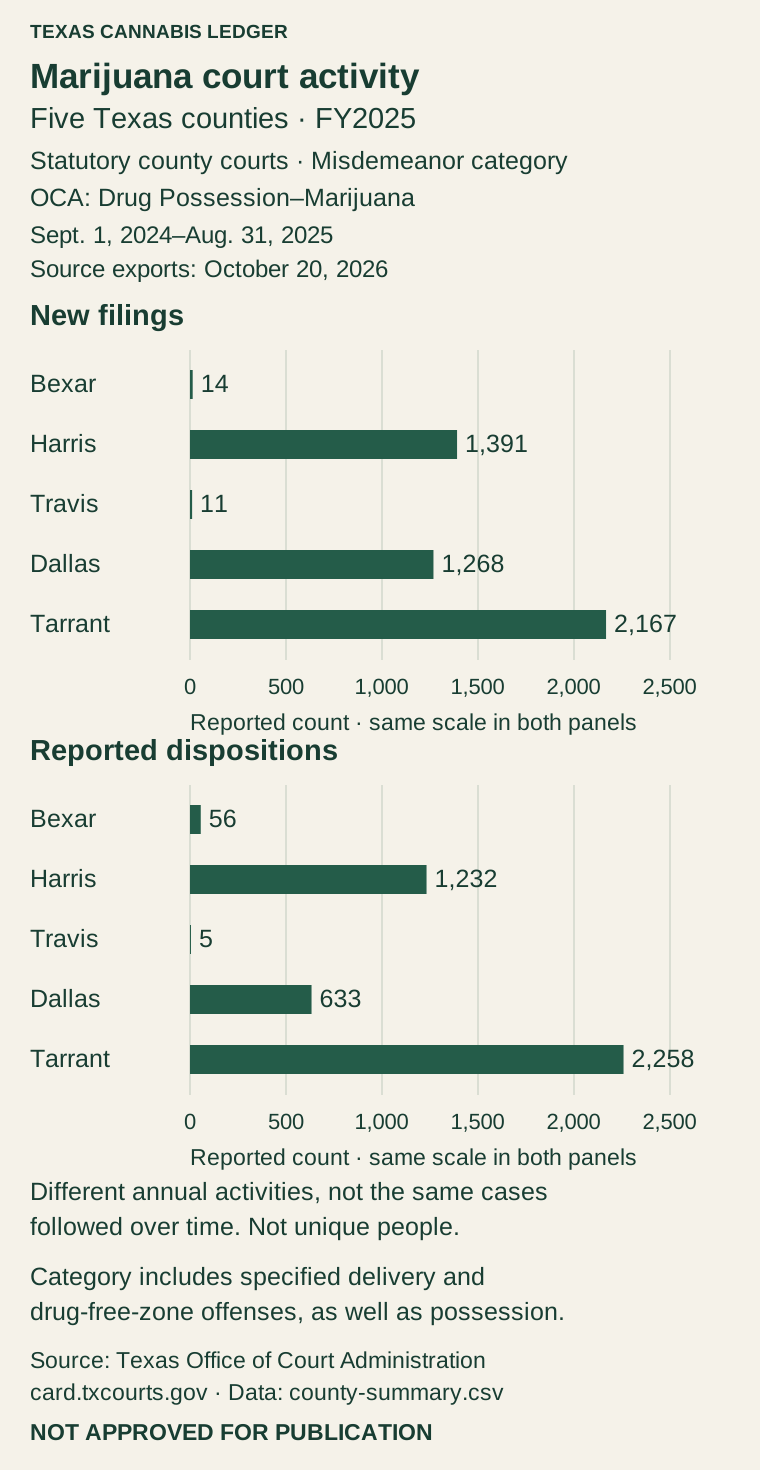
Texas court reports show substantially different volumes of activity in the Office of Court Administration's “Drug Possession–Marijuana” category across five counties. For FY2025, the retained reports list 2,167 new filings in Tarrant County, 1,391 in Harris, 1,268 in Dallas, 14 in Bexar and 11 in Travis.
On this page 8 sections
Reporting period: Texas FY2025 · September 1, 2024–August 31, 2025 · OCA exports retrieved October 20, 2026
Those are reported filings in a specific statutory county-court category. They are not marijuana arrest totals or counts of unique people. Despite its short name, the category includes specified misdemeanor delivery and drug-free-zone offenses as well as possession.
TCL reproduced the figures from OCA's retained query exports and checked them against separate standard reports. All five counties' required misdemeanor reporting offices have twelve monthly reports marked received and in balance in the retained coverage workbook. That reporting status does not certify that every underlying case was classified correctly.
Filings and dispositions are different activities
| County | New filings | Reported dispositions | Dismissal entries | Sum of reported conviction rows* |
|---|---|---|---|---|
| Bexar | 14 | 56 | 45 | 1 |
| Harris | 1,391 | 1,232 | 1,019 | 186 |
| Travis | 11 | 5 | 5 | 0 |
| Dallas | 1,268 | 633 | 513 | 81 |
| Tarrant | 2,167 | 2,258 | 1,485 | 327 |
The final column sums OCA's guilty-plea, court-conviction and jury-conviction rows in the original-charge category. A lesser-offense conviction remains in that original category under the reporting instructions. These figures therefore do not establish the number convicted of marijuana possession as the final offense.
Source: OCA Court Activity Database, Statutory County → Criminal → Drug Possession–Marijuana; FY2025. The retained October 20 query vintage is cross-checked against Statutory County Court Activity Detail reports. The figures exclude constitutional county-court probes, felony categories and juvenile categories.
What counts as a marijuana case here?
OCA's official category definition includes misdemeanor offenses under Health and Safety Code §481.120 (delivery), §481.121 (possession) and §481.134(f) (drug-free zones). The category should not be reduced to possession alone or broadened to all cannabis-related cases. The official category definitions and historical statutory county-court instructions establish that scope.
Under those instructions, cases are based on defendants named in an information or complaint. One person can appear in multiple cases. A multi-count case is assigned to the most serious alleged offense, and a disposition remains in its original charge category even if the final conviction is for a lesser offense.
The study's source crosswalk records these historical rules separately from later instructions. No source proves that every reporting office followed them correctly in every instance.
Can these figures tell us what happens after an arrest?
No. The tables contain aggregate court activity during a fiscal year, not individual cases followed from arrest to final outcome.
Some FY2025 dispositions concern cases filed before FY2025. Some FY2025 filings were not disposed of during that year. Revocation-motion activity also appears in the reports. Dividing convictions, dismissals or dispositions by that year's new filings would not produce a defensible outcome probability.
The DPS arrest-record data elsewhere on TCL uses different definitions and calendar-year periods. These OCA reports contain no validated linkage to those arrest records. A court count cannot be subtracted from an arrest count to infer unprosecuted cases.
Why do the counties differ?
The retained records establish the differences in reported activity. They do not establish why those differences exist.
Population, charging and diversion practices, the timing of case processing, reporting coverage and classification could all affect the totals. This study does not measure their contributions. Counts alone do not establish comparative enforcement intensity, a resident's risk, or a policy effect.
The five counties were the existing feasibility pilot. They are not a representative sample of Texas counties or a ranking of all counties.
How TCL checked the numbers
TCL re-read the 161 retained query exports and verified their recorded hashes and printed criteria. Across the five counties plus separate statewide controls, 132 annual/monthly comparisons, 126 standard-report comparisons and 78 disposition-leaf checks agree.
For the five pilot counties, pending active and inactive cases also reconcile using the source docket adjustments. Opening and closing stocks come from the first and last month, rather than sums of twelve monthly stock values. Reactivation and inactivation are internal transfers, not new cases.
The retained reports-received workbook marks all 60 required pilot county-month reports received and in balance. It uses designated reporting offices; courts not required to report separately are not automatically missing reports.
The downloadable aggregate package contains annual source cells, retrieval dates, source hashes, a data dictionary and portable reproduction instructions. It reproduces the annual table arithmetic, not the complete raw extraction or private monthly reconciliation. Raw court evidence is not included.
Why this is not a statewide court-outcomes study
The statewide controls have unresolved differences. The retained live statewide report's pending-stock identity has a 53-case residual after its recorded adjustments. The fixed FY2025 publication and the live-query vintage also differ in several fields. Those are separate issues.
Neither issue was resolved by editing source values. This five-county analysis does not claim statewide reconciliation or completeness. Its county figures have their own matching query exports, standard reports and coverage checks.
OCA's FY2025 reporting notes distinguish publication-time figures from the live database. A later query may therefore differ from this retained snapshot. This report identifies its source vintage so its calculations remain reproducible.
Source and reuse notes
Primary source: Texas Office of Court Administration, Court Activity Reporting. Query report parameters, file hashes and retrieval timestamps are necessary to identify this particular snapshot; the portal URL alone is insufficient.
Suggested attribution: “Texas Cannabis Ledger analysis of Texas Office of Court Administration statutory county-court reports, FY2025; source exports retrieved October 20, 2026.” Cite the specific table and retained source vintage, and link this report. TCL performed the compilation and calculations; OCA supplied the underlying government records.
TCL's compilation and reconciliation are distinct from OCA's government records. No endorsement by OCA, independent novelty, individual outcome inference or blanket redistribution license is claimed.
Download the evidence and reproduce the table
The aggregate download is a reusable research aid. It contains no personal case records or original court workbooks.
- Complete aggregate calculation bundle · ZIP
- Five-county summary · CSV
- 110 annual aggregate source cells · CSV
- 35 numerical claims and definitions · JSON
- Reporting coverage · JSON
- Source identities and vintages · JSON
- Data dictionary · JSON
- Methodology · Markdown
- Portable reproduction · Python
- Package checksums · JSON
After extracting the bundle, run python3 -I reproduce.py. Python's standard library is sufficient. The script checks file hashes and reproduces the annual county summary from the exported aggregate cells. It does not independently acquire OCA records or repeat all private monthly and stock-reconciliation checks.